
Australia's drowning deaths among children under five fell to 11 in 2025/26. That is 39% below the 10-year average, and Royal Life Saving credits "sustained investment in pool fencing, legislation, and public education" (National Drowning Report 2026). The same report puts 55% of those deaths in backyard swimming pools. Our working: 55% of 11 is 6.05. By our estimate, that means about six young children drowned in a backyard pool in a year the numbers were improving.
The fence at home is still where the job is. National Water Safety Day falls on the first day of summer, 1 December, just before the pool's busiest weeks. That makes it a good day for one last walk-round of the barrier.
It is an awareness day, not a deadline. The NSW Government says owners must keep a child-resistant barrier in place "at all times". This note gives you the order to walk it in, and the things owners most often miss. For the full list, our pre-summer pool fence checklist sits alongside it.
Why does National Water Safety Day matter for a backyard pool?
Drowning deaths in Australia
Children under five, 2025/26
39% below 10-year average
55%: in backyard swimming pools
The Australian Government supported peak bodies including Surf Life Saving and Royal Life Saving Australia to declare the day "to raise awareness to prevent drowning and promote safe practices around water". Surf Life Saving Sydney lists the 2026 National Water Safety Day on 1 December.
The national picture is mixed. Australia recorded 313 drowning deaths in 2025/26, down from the record 357 in 2024/25 but still 10% above the 10-year average. Our working puts that at 44 fewer deaths than the year before (357 minus 313).
For pool owners, one line from the NSW Government matters most: drowning in swimming pools is a leading cause of preventable death in children under 5. The fence is the part of that you control.
Where to start the walk-round: the pool gate
- 1Gate: swings outwards away from the pool, shuts automatically from any open position, self-latches, never propped open
- 2Fence line: bottom gap no bigger than 10 cm, vertical bar gaps no more than 10 cm, fixings tight
- 3Non-climbable zone: 90 cm arc from the top of the fence toward the ground, plus 30 cm inside the pool area, clear of footholds and handholds
- 4Boundary section: 1.8 m high where a boundary fence is part of the pool fence
- 5CPR sign: near the pool, good condition, readable from 3 m
Saltwater & Steel's advice is to walk the barrier in the same order every time, and to start at the gate, because it is the part that moves.
Gate check
The NSW Government's gate list is short. The gate is never propped open. It swings outwards, away from the pool. It shuts automatically from any open position without being forced, and it self-latches.
"Any open position" is the test owners skip. Open the gate fully and let go. Then try it half open, and then barely ajar. A gate that slams from wide open but stalls a hand's width from the latch fails where it matters.
While you are there, follow the same page's maintenance steps: check bolts, screws and fasteners are tight, and lubricate self-closing hinges, locks and latches with lubricating oil or silicone.
On a block near the water, do this more than once a summer. Salt sits on hinges and latches, and a stiff spring is easy to miss until the gate stops short. Our notes on gates and self-closing latches and coastal fencing care in Newcastle go further.
Pool safety fence height and gaps: what to measure
| What to measure | NSW requirement | Tick |
|---|---|---|
| Fence height | at least 1.2 m from finished ground level; 1.8 m where a boundary fence is part of the pool fence | |
| Gap under the fence | no bigger than 10 cm | |
| Gaps between vertical bars | no more than 10 cm | |
| Horizontal climbable bars | at least 90 cm apart | |
| Mesh or perforated barrier at 1.2 m high | holes no greater than 13 mm |
Take a tape measure on the second leg of the walk. The NSW Government sets these key measurements (pool owner obligations):
- The fence is at least 1.2 m high from finished ground level, with no bottom gap bigger than 10 cm.
- Where a boundary fence is part of the pool fence, that boundary fence must be 1.8 m high.
- Gaps between vertical bars are no more than 10 cm.
- Horizontal climbable bars are at least 90 cm apart.
- A mesh or perforated barrier at 1.2 m has holes no greater than 13 mm.
The bottom gap is the one that drifts. Mulch washes away, pavers settle and lawn wears down along the fence line, so a gap that measured fine when the fence went in can open up over a wet spring.
The 1.8 m boundary section ties in with the neighbour rules. Our note on how high a boundary fence can be covers that side. The edition of the Australian Standard your pool is assessed against depends on its history, and we set that out in which pool fence standard applies to your NSW pool.
What has crept into the non-climbable zone since winter?
- 90 cm non-climbable zone, measured in an arc from the top of the fence toward the ground
- 30 cm inside the pool area: no footholds or handholds
This is where a compliant fence most often stops working. The NSW Government says trees, shrubs and objects such as a barbecue, pot plants, toys, ladders and chairs must not be within the 90 cm zone. The zone is measured in an arc from the top of the fence toward the ground.
It works on both sides. The zone extends 30 cm inside the pool area, which should be clear of footholds and handholds.
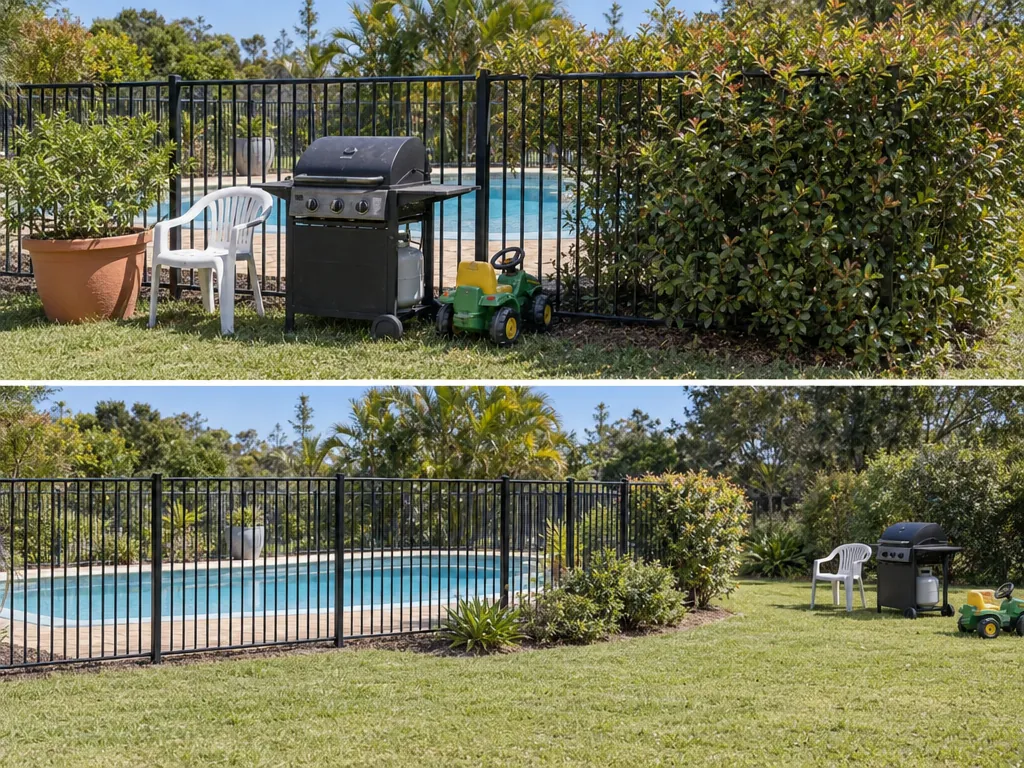
Spring is when it fills up. The shrub you planted to soften the fence has grown to the top rail. The new outdoor setting landed against the panels. The barbecue was wheeled over for the first cook-up, and the kids' ride-on is parked where it was last used. Walk the full length of the outside and look at the fence the way a three-year-old would: for anything to stand on.
Pool safety fence regulations owners most often get wrong
These are the points that catch people out, all from the NSW Government's pool owner obligations page.
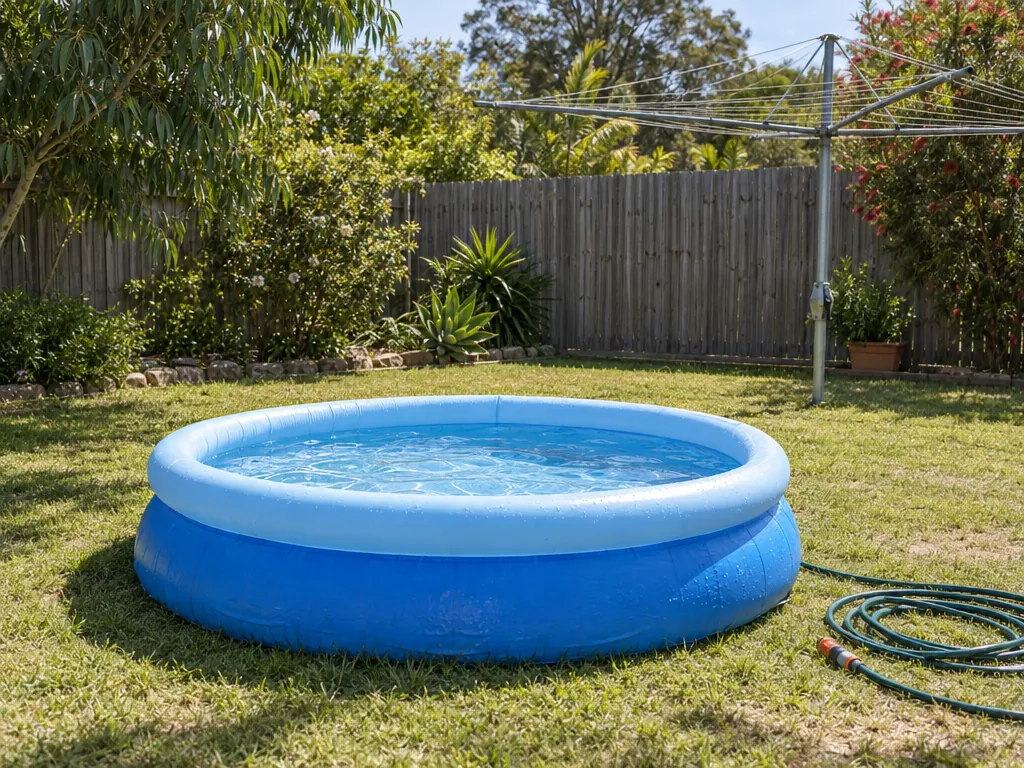
Portable pools count. Portable and inflatable pools are covered: any pool that can hold more than 30 cm of water needs a compliant barrier. Pools over 2,000 L may also need development approval, so check with your council before you fill one.
Registered is not the same as compliant. As the NSW Government puts it, "registering a pool does not mean that it meets compliance requirements". Compliance is assessed separately, by an inspection from council or a registered certifier. Pools are registered against the property address, not the owner's name.
Renovations can end an old exemption. If the barrier is modified or altered, including house and yard renovations, the current Act, Regulation and AS 1926.1-2012 apply and previous exemptions cease. A new deck or a moved back door can bring the whole barrier under current rules.
Doors and windows. Using doors or windows as part of the pool barrier "is no longer allowed".
The certificate has a shelf life. A certificate of compliance is valid for 3 years, and councils and registered certifiers inspect and issue it. If you plan to sell or rent, the page advises contacting them early to leave time for an inspection. Councils enforce barrier compliance and can direct owners to take action.
Some certifiers may do minor repairs of up to $1,000 (materials and labour) to enable a certificate (checked November 2026), and you are free to hire another tradesperson instead.
The CPR sign, and the supervision no fence replaces
Required near the pool, including portable pools; keep it in good condition.
New signs from 1 Sep 2019; existing pools only need the new sign if the barrier is substantially altered or rebuilt.
The last stop on the walk is the sign. A CPR sign must be displayed near the pool, including portable pools, in good condition and readable from 3 m away. Stand back 3 m and read it. Sun-faded print and a sign hidden behind a grown-out plant are both easy fixes.
New signs came in on 1 September 2019. Existing pools only need to update the sign if the barrier is substantially altered or rebuilt.
A fence buys time. It does not watch the pool. Royal Life Saving NSW calls the day a chance to "refresh lifesaving skills, improve supervision practices, understand local hazards". Two of its calls to action belong with any backyard pool: learn CPR, and provide "constant, close, active adult supervision within arm's reach around any water".
Heading to a Newcastle beach this summer
- Saturday 26 Sep 2026NSW beach patrol season starts
- 1 Dec 2026National Water Safety Day (first day of summer)
- Monday 26 Apr 2027patrol season ends
129 NSW beaches patrolled on weekends and public holidays.
Source: Surf Life Saving Australia: FAQs, Surf Life Saving Sydney: 2026 National Water Safety Day, Australian Sports Commission: National Water Safety Day.
Water Safety Day is about the whole summer, and for plenty of Newcastle households summer means the beach as much as the pool. The 2026/27 NSW beach patrol season runs from Saturday 26 September 2026 to Monday 26 April 2027, with 129 NSW beaches patrolled on weekends and public holidays. Surf Life Saving points to beachsafe.org.au to find a patrolled beach.
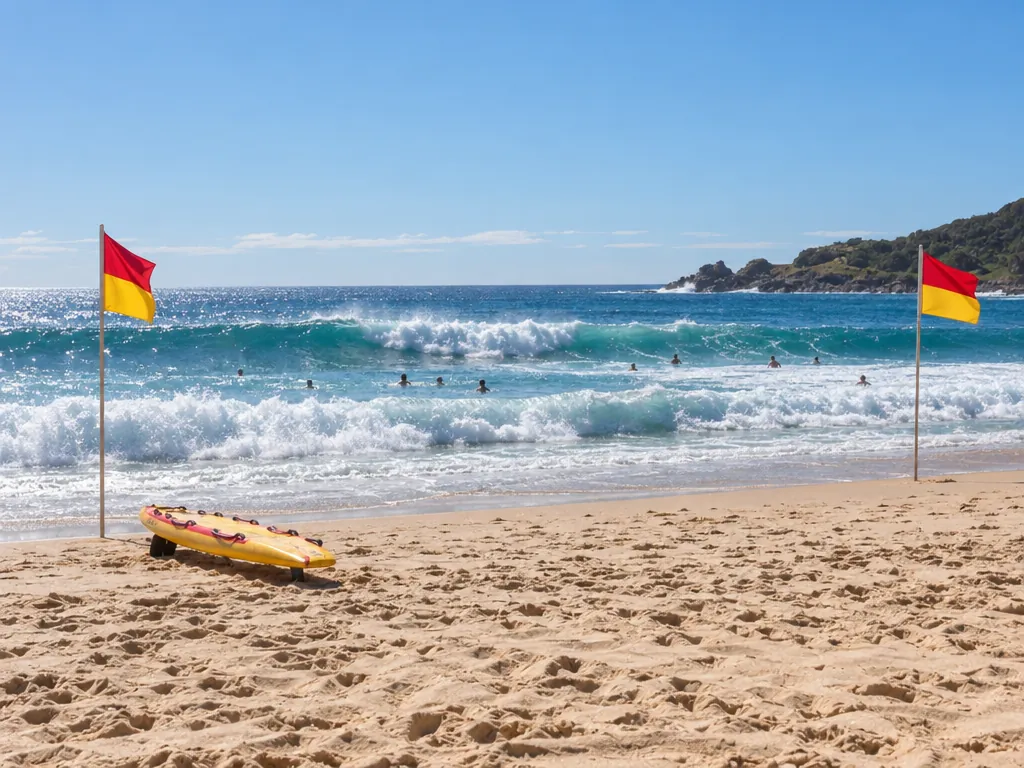
Royal Life Saving NSW's advice is simple: swim at patrolled beaches between the red and yellow flags, and wear a properly fitted lifejacket when boating, paddling or rock fishing.
Your pool fence walk-round at a glance
Gate
- Never propped open
- Swings outwards, away from the pool
- Shuts automatically from any open position
- Self-latches
Height
- At least 1.2 m from finished ground level
- 1.8 m where a boundary fence is part of the pool fence
Gaps
- Bottom gap no bigger than 10 cm
- Vertical bar gaps no more than 10 cm
- Horizontal climbable bars at least 90 cm apart
- Mesh or perforated holes at 1.2 m no greater than 13 mm
Climbable zone
- 90 cm arc from the top of the fence, plus 30 cm inside the pool area
Paperwork
- CPR sign readable from 3 m
- Certificate of compliance valid for 3 years
Five stops, the same order every time: gate, fence line, climbable zone, boundary section, sign. Every figure on the card comes from the NSW Government's pool owner obligations page. Save it on your phone and walk it again whenever the yard changes.
When the walk-round turns something up
Most of what you find on the walk is yours to fix in an afternoon: move the chair, cut back the shrub, oil the hinge, replace the faded sign. Some of it is not. That includes a gate that won't latch from every position, a section short of height, a bottom gap that keeps opening, and a renovation that has touched the barrier.
For those, tell Saltwater & Steel what you found through our enquiry page, and we'll pass it to a local fencing builder who can measure and quote the repair. You can read more on pool fencing in Newcastle first. A certificate of compliance itself comes from your council or a registered certifier.
Sources
- https://rlssq.com.au/national-drowning-report/
- https://www.ausport.gov.au/clearinghouse/evidence/water-safety/national-water-safety-day
- https://sls.sydney/event/2026-national-water-safety-day/
- https://www.nsw.gov.au/housing-and-construction/building-or-renovating-a-home/pools-and-pool-safety/owner-obligations
- https://royallifesaving.wixstudio.com/rlsnsw/campaigns/national-water-safety-day
- https://www.surflifesaving.com.au/frequently-asked-questions