
If your neighbour won't agree on a dividing fence, the formal route in NSW takes roughly two months from serving a Fencing Notice to a first NCAT listing. That is our estimate, and the working is short. You can apply for Fencing Orders only if a Fencing Notice was served at least a month earlier. After that, NCAT aims to list cases within four weeks. One month plus about four weeks comes to about eight weeks, and that is before anyone has sat down at conciliation. Local Court waiting times vary.
Most fences never get near a tribunal. Under the Dividing Fences Act 1991, neighbours normally share equally the cost of building a dividing fence where there is none. The same goes for repairing or replacing one that is damaged, destroyed, deteriorated or not "sufficient". Our note on who pays for a shared boundary fence covers that basic split.
What follows is everything around it:
- the six cases where costs may not be shared equally
- the notice steps and their time limits
- urgent repairs
- retaining walls
- finding the boundary
This is general information, not legal advice. For a specific dispute, speak to a legal adviser.
When the Dividing Fences Act NSW doesn't split the cost 50/50
- Sufficient fence: cost normally shared equally
- Higher standard: the owner who wants it usually pays the difference
- Part of a pool fence: pool owner usually pays (Swimming Pools Act 1992, s 33)
- Retaining wall counts as a fencing cost only where it supports the fence
- Council neighbour: doesn't have to contribute, can be negotiated
Fence damaged by one neighbour or their tenant: cost may not be shared equally
Source: Legal Aid NSW, State Library of NSW.
Legal Aid lists six situations where costs may not be shared equally:
- One neighbour wants a fence above the "sufficient" standard.
- One neighbour or their tenant damaged or destroyed the original fence.
- One neighbour offers to pay the whole cost.
- The neighbour is a public authority such as a council.
- The fence is also part of a pool fence.
- The work was done without agreement or a Fencing Order, unless it was urgent.
Three of those come with a usual answer.
A better fence than the boundary needs. You usually pay the difference between a sufficient fence and the one you want.
A council reserve next door. Public authorities such as councils don't have to contribute, though you can negotiate.
A pool on one side. The pool owner usually pays for that section. The State Library guide puts the extra pool-compliance expenses on the owner of the property that contains the pool, under the Swimming Pools Act 1992, s 33. The pool section of the fence has its own height rule as well: a boundary fence that is part of the pool fence must be 1.8 m high. The standard changes we covered in which pool fence standard applies to your NSW pool are about how a barrier is built. They don't change who pays.
The shared cost also covers more than posts and panels. Under the Act, fencing costs include design, surveying, preparing or altering the land, planting, trimming or lopping vegetation, and a retaining wall that supports the fence. There is one limit on the vegetation work. A neighbour who wants extra trimming, lopping or removal of vegetation beyond what the fencing work needs pays for the extra.
What counts as a "sufficient" fence on your block
State Library case study
Source: State Library of NSW.
The Act doesn't choose a fence for you. Legal Aid says the law in NSW doesn't say what type of fence you must build. Neighbours contribute equally to a "sufficient dividing fence", meaning one that adequately separates the two properties.
When a tribunal has to decide what is sufficient, it weighs several things under s 4. The State Library guide lists the existing fence, land use, privacy, the usual fence in the locality, local government policy and environmental planning instruments.
Height can move a long way. In a case study on that page, a tribunal ordered a 1800 mm fence where the old one was 900 mm, which matched the local council maximum. The old fence is a starting point, not a ceiling.
On a coastal block, material is often the sticking point: steel or timber, sheet or slat. You agree that between you, or a tribunal orders it. The Act doesn't fix it. These notes can help:
- Colorbond vs timber near the water and steel boundary fencing near the coast weigh up the options.
- How high a boundary fence can be covers council limits.
Check those limits early. Legal Aid notes that many councils limit fence height and some limit materials, for example in bushfire-prone areas. Covenants, easements and restrictions on user on the title can also limit the fence.
If your neighbour won't agree: the fencing notice route
Talk, with at least two quotes (both designs if you disagree on material)
Mediation: optional, before or after the notice
Day 0: serve the Fencing Notice
1 month: no agreement or no reply
Apply to NCAT (Consumer and Commercial Division) or the Local Court for Fencing Orders
NCAT aims to list within about 4 weeks and starts with conciliation; Local Court waiting times vary
Orders can cover material, height, location, timing and cost split
Source: Legal Aid NSW.
Start by talking, with paper in hand. Legal Aid suggests getting at least two quotes, plus quotes for both designs if you disagree on material. Mediation can be tried before or after the notice and isn't compulsory.
If talking stalls, either neighbour can serve a Fencing Notice. If you still can't agree after a month, or there's no reply, either of you can apply to the Local Court or NCAT for Fencing Orders.
A Fencing Order can cover the fence's material, height, location, timing and cost split. NCAT's Consumer and Commercial Division and the Local Court can make the same orders. NCAT starts with conciliation, so a hearing isn't the first step. Nobody can tell you in advance how a tribunal will split the cost.
Write everything down as you go. Legal Aid notes that written records of your attempts to resolve it matter if you later seek a fencing order.
What goes in a fencing notice, and how to serve it
| Item | Legal Aid suggests | s 11 minimum (State Library guide) |
|---|---|---|
| Statement that it's a notice under the Dividing Fences Act 1991, s 11 | Yes | |
| Both addresses | Yes | |
| Location of the work, or the boundary or proposed fence line | Yes | Yes |
| Description of the fence: length, height, materials, or the type of work | Yes | Yes |
| Who will do the work | Yes | |
| Start and finish dates | Yes | |
| Estimated cost | Yes | Yes |
| How the cost is split, or any non-equal share | Yes | Yes |
| Written quote attached | Recommended | |
| Serve by hand or by post to the owner's usual or last known address. Keep a copy and note the date. | ||
Source: Legal Aid NSW, State Library of NSW.
There is no set Fencing Notice form. Legal Aid suggests including:
- a statement that it is a notice under s 11 of the Dividing Fences Act 1991
- both addresses
- the location of the work
- a description of the fence, with length, height and materials
- who will do the work
- start and finish dates
- the estimated cost
- how the cost is split
- a written quote attached (recommended)
The legal minimum is shorter. The State Library guide says s 11 itself requires only the boundary line (or proposed fence line), the type of work, and the estimated cost, with any non-equal share. Covering Legal Aid's fuller list leaves less to argue about later.
Serving it. Hand it over personally or post it to the owner's usual or last known address. Keep a copy and note the date, because the month before anyone can apply for orders counts from service.
If a tenant lives there. Legal Aid says the notice goes to the owner. The State Library guide adds that a notice can go to a tenant only if five or more years remain on the tenancy.
The traps that cost money
Fencing work needs both owners' agreement, and Legal Aid says any agreement should be written down and signed by both neighbours.
Skipping agreement has a price. Work done without agreement or a Fencing Order, unless it was urgent, is one of the cases where the cost may not be shared at all.
Access is the second trap. Without permission, you can't enter a neighbour's land to do fencing work unless one of these applies:
- there is an agreement
- there is a court or NCAT order
- there is an Access to Neighbouring Land Act order
- the work is urgent
Otherwise it is trespass.
A sale next door is the third trap. An agreement or order does not pass to the next owner: the State Library guide says it is not binding on subsequent owners if a property is sold. If the house sells partway through, you may need to start again with the new owner.
Urgent fence repairs after a storm
Source: Legal Aid NSW.
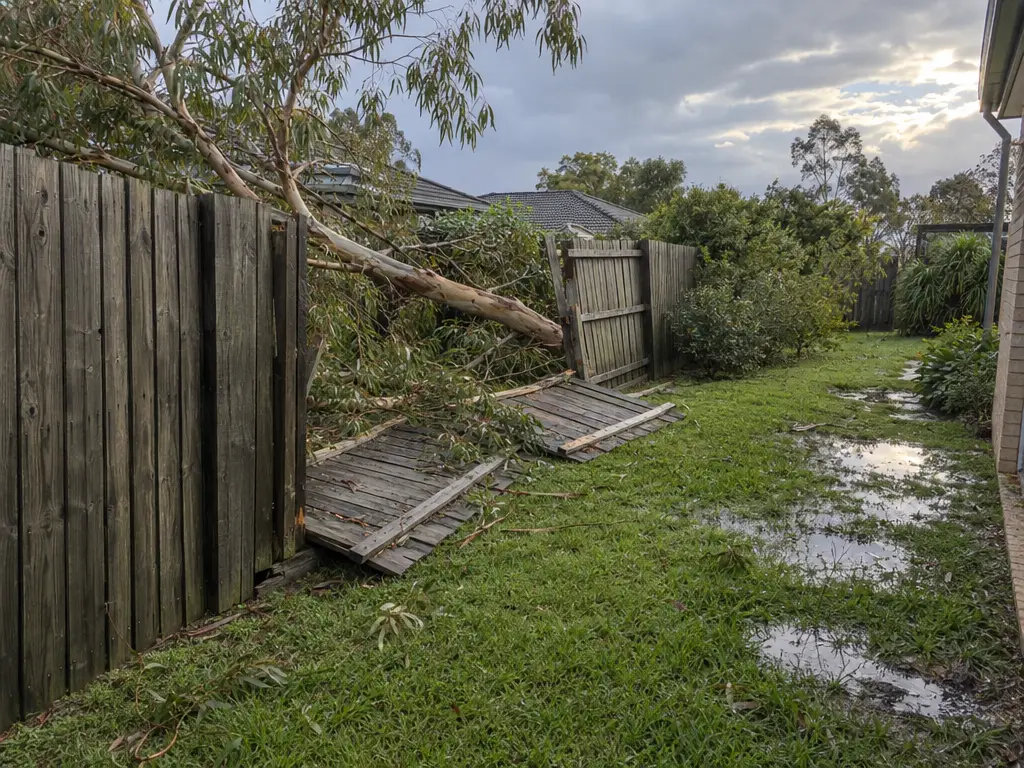
A storm flattens three panels. Can you fix it now and send the bill later? Sometimes, but the rules are narrow.
Urgent work is allowed only where a dividing fence was damaged or destroyed. There is no urgent claim if there was never a fence. It must also have been impractical to serve a notice, for example because you needed to secure your land. Even then, the tribunal may disagree that it was urgent. If the work does qualify, you can claim half the cost.
The deadlines run from the day the work is finished:
- You must file a claim for half the cost within six years of completion.
- A neighbour who disputes your claim must apply within one month of completion, though the court or tribunal may allow a late application.
Photograph the damage before anything is cleared away. Those photos show that a fence existed and what state it was in.
Retaining walls under a dividing fence
Legal Aid: no council approval needed if all of these apply
A wall under a boundary fence is unlikely to meet the 1 m rule.
Source: Legal Aid NSW.
Stepped blocks bring retaining walls into the fence question. A retaining wall comes under the Dividing Fences Act only where it is necessary for the support and maintenance of the dividing fence.
Legal Aid advises getting an independent structural engineer's report and legal advice. NCAT won't hear retaining wall matters without evidence of that link to the fence, and most such disputes go to the Supreme Court.
Council approval is a separate question. Legal Aid says a retaining wall needs no council approval if it meets all of these conditions, and to check with your local council before building:
- under 60 cm above or below ground
- at least 1 m from any boundary, easement, sewer or water main
- at least 2 m from any other retaining wall on the property
- no heritage or environmentally sensitive area impact
- not in a flood control area, and at least 40 m from a natural water body
A wall sitting right under a boundary fence is unlikely to clear the 1 m rule.
When you can't agree where the boundary is
Day 0: you serve a Boundary Notice
Within 7 days: neighbour pegs the line or hires a registered surveyor, and tells you in writing
If the surveyor confirms the neighbour's pegged line, the neighbour can claim their costs from you.
After 1 month, if the neighbour has not hired a registered surveyor or has only pegged the line: you can hire a registered surveyor, costs usually shared equally
Source: Legal Aid NSW.
A dividing fence will usually go on the common boundary line, so you need to know where that is. If you disagree about where it is, Legal Aid says you can serve a Boundary Notice.
Your neighbour then has 7 days to do one of two things, and must tell you in writing:
- peg the line, or
- hire a registered surveyor.
If they don't hire a registered surveyor, or only peg the line, within one month, you can then hire a registered surveyor yourself, with the costs usually shared equally.
There is a catch on the other side. If the surveyor confirms the neighbour's pegged line was right, the neighbour can claim their costs from you.
Before you talk to your neighbour: a short checklist
Source: Legal Aid NSW.
Saltwater & Steel's view is simple: sort the paperwork before anyone digs a post hole. A conversation with real numbers on the table goes better than one without.
- Quotes. It may help to have at least two, and quotes for both designs if you disagree on material, as Legal Aid suggests.
- Council and title. Check council height and material rules and any covenants, easements or restrictions on user on the title.
- Underground services. Before excavating for a fence or retaining wall, lodge a free Before You Dig Australia enquiry.
- Agreement. Write it down, both sign it, and keep a copy.
- Records. Keep a dated note of every conversation and message.
If the basic split is all you need, our who pays for a shared boundary fence note covers it.
Every time limit in one place
- 7 daysneighbour's time to peg the line or hire a surveyor after a Boundary NoticeLegal Aid NSW
- 1 monthtime to respond to a Fencing Notice before either side can apply for ordersLegal Aid NSW
- About 4 weeks after applicationNCAT target listing timeLegal Aid NSW
- Within 1 month of completiontime to challenge an urgent-work cost claimLegal Aid NSW
- Within 6 years of completiontime to claim half the cost of urgent fencing workLegal Aid NSW
Five clocks can run in a fence dispute:
- 7 days. Your neighbour's time to peg the line or hire a surveyor after a Boundary Notice.
- 1 month. The wait after a Fencing Notice before either side can apply for orders.
- About 4 weeks. NCAT's target listing time after an application.
- 1 month and 6 years. The two limits on urgent work claims, both counted from completion: one month for a neighbour to dispute a claim, six years for you to make one.
Miss one and you may lose the step it protects.
Your next step
The most useful thing to bring to your neighbour is a written quote. It should spell out the fence's length, height and materials, which are the same details a Fencing Notice asks for. Through our enquiry page you can book a free measure, and a local fencing builder comes back with a written quote you can take to the conversation. If a pool shares the boundary, our pool fencing page covers pool fences.
Sources
- https://www.legalaid.nsw.gov.au/my-problem-is-about/my-neighbour/fences/your-rights-and-obligations
- https://www.legalaid.nsw.gov.au/my-problem-is-about/my-neighbour/fences/what-if-we-cant-agree
- https://www.legalaid.nsw.gov.au/my-problem-is-about/my-neighbour/fences/what-if-we-cant-agree/step-by-step-guide-preparing-a-fencing-notice
- https://www.legalaid.nsw.gov.au/my-problem-is-about/my-neighbour/fences/fencing-orders
- https://www.legalaid.nsw.gov.au/my-problem-is-about/my-neighbour/fences/urgent-fencing-work
- https://www.legalaid.nsw.gov.au/my-problem-is-about/my-neighbour/fences/retaining-walls
- https://www.legalaid.nsw.gov.au/my-problem-is-about/my-neighbour/fences/boundaries
- https://www.legalaid.nsw.gov.au/my-problem-is-about/my-neighbour/fences/talk-to-your-neighbour
- https://www.sl.nsw.gov.au/find-legal-answers/books-online/neighbours-and-law/dividing-fences
- https://www.nsw.gov.au/housing-and-construction/building-or-renovating-a-home/pools-and-pool-safety/owner-obligations