
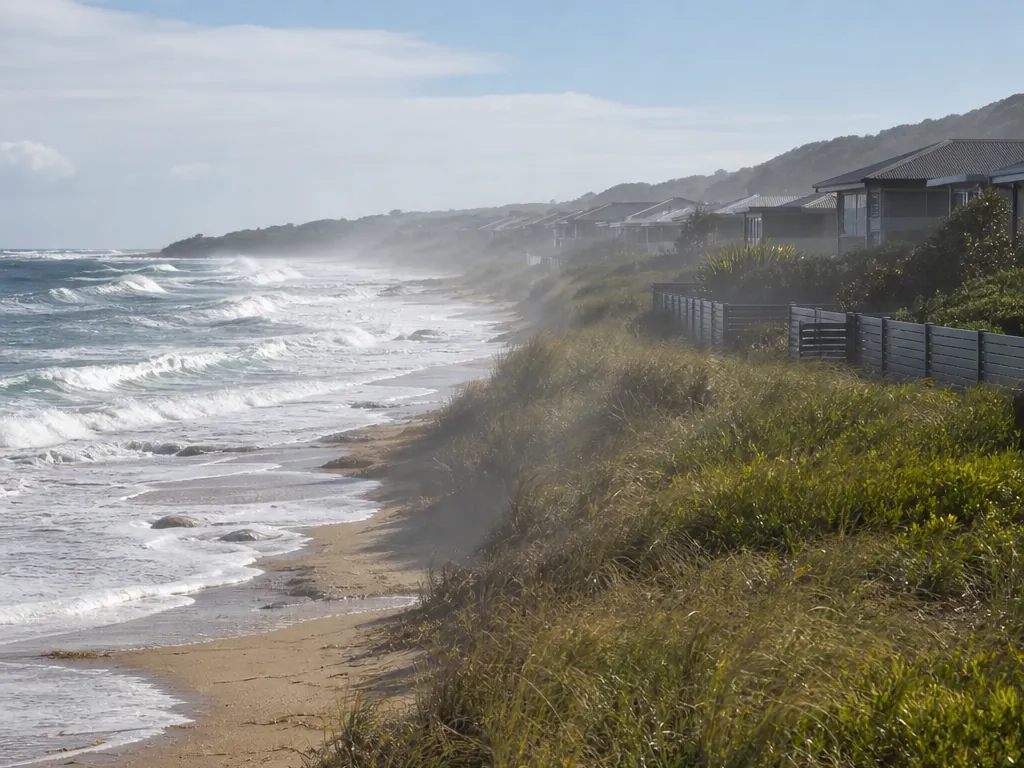
If you're putting up steel fencing near Newcastle's coast, choose the coating for the corrosion category of your exact site. That category can be harsher than your distance to the beach suggests.
Here's the working behind that. A coatings supplier republishes the commonly used AS 4312 corrosivity table, and Newcastle is named in three of its four coastal categories. C3 "Coastal" lists Newcastle among its metro examples. C5 "Surf seashore" reaches "more than 500 metres from the coast in some areas of Newcastle". CX "Severe surf shoreline" names "Some Newcastle beaches". Only C4 leaves the city out. That count of three in four is ours, made from that table. It means one city spans almost the whole coastal scale.
Coating thickness is the other lever. A galvanizer's technical FAQ says galvanized coating life is "generally directly proportional to the coating thickness". Its worked example gives 85 µm of zinc in a C4 environment roughly 20 to 40 years before first maintenance. Our estimate from those two statements: half that zinc in the same C4 setting would reach first maintenance in roughly half the time, about 10 to 20 years. Both figures are estimates for a stated coating and category, not promises about your fence.
So the order runs like this: confirm the category, match the coating to it, then keep the salt off. Our earlier piece on steel boundary fencing near the coast covers salt-air basics and the neighbour rules. This one goes further into categories, coatings and care.
What do C3, C4, C5 and CX mean for a fence?
| Category | How it is commonly summarised | Newcastle mention |
|---|---|---|
| C3 "Coastal" | 1 to 10 km inland along ocean front areas with breaking surf and salt spray, extendable inland by prevailing winds | Metro examples include Newcastle |
| C4 | 200 m up to 1 km inland with rough seas and surf, extendable by prevailing winds; also shoreline to 50 m inland around sheltered bays and the immediate vicinity of calm salt water such as harbour foreshores | |
| C5 "Surf seashore" | Within 200 m of rough seas and surf beaches | More than 500 m from the coast in some areas of Newcastle |
| CX "Severe surf shoreline" | Very high salt deposition | Some Newcastle beaches |
Commonly summarised from AS 4312 as republished by a coatings supplier. Confirm the category for your address.
Two Australian Standards do most of the work here: AS 4312 for steel and AS/NZS 2312.2 for zinc and galvanizing. Hot-dip galvanizing after fabrication is covered by AS/NZS 4680. AS 4312 includes maps estimating corrosivity zones for several major cities. The corrosion rates in the Australian standards are consistent with ISO 9223 and ISO 14713.1.
One coatings supplier's corrosivity ratings page republishes the categories, and this is how they are commonly summarised:
- C3, "Coastal": 1 to 10 km inland along ocean front areas with breaking surf and salt spray, extendable inland by prevailing winds. The listed metro examples include Newcastle.
- C4: 200 m up to 1 km inland in areas with rough seas and surf, extendable by prevailing winds. It also takes in the shoreline to 50 m inland around sheltered bays, and the immediate vicinity of calm salt water such as harbour foreshores.
- C5, "Surf seashore": within 200 m of rough seas and surf beaches, and more than 500 metres from the coast in some areas of Newcastle.
- CX, "Severe surf shoreline": very high salt deposition, with some Newcastle beaches given as the example.
Look at the C4 harbour line. Calm water still counts. A fence on a harbour foreshore can sit in a higher category than one several kilometres inland from the surf.
Our advice at Saltwater & Steel is to treat these descriptions as a starting point, not a verdict. Have the category confirmed for your address.
Why distance from the beach is only half the answer
Where the salt goes
- CXVery high salt deposition; some Newcastle beaches
- C5Within 200 m of rough seas and surf beaches; more than 500 m from the coast in some areas of Newcastle
- C4200 m up to 1 km inland, extendable by prevailing winds
- C31 to 10 km inland, extendable inland by prevailing winds
C4: immediate vicinity of calm salt water, and shoreline to 50 m around sheltered bays
Not regularly washed by rain: hose it
Commonly summarised categories. Your site decides yours.
Source: Intumescent Coating Systems: corrosivity ratings, COLORBOND FAQ.
A single distance from the beach doesn't settle your category. The zones are extendable inland by prevailing winds, C5 reaches more than 500 metres from the coast in some areas of Newcastle, and shelter matters too, which is why areas not regularly washed by rain need hosing.
On your own block, look at three things:
- which way the fence faces the onshore wind
- whether anything stands between the fence and the water
- which sections sit under eaves, carports or dense planting where rain never reaches
The sheltered metre behind the carport can be the worst-off part of the whole fence.
If you're close to the surf, our page on fencing in Merewether and the Newcastle beaches is a good next read.
How much zinc does a coastal steel fence need?
- Step 1Steel thicker than 6 mm
- Step 2AS/NZS 4680 minimum average zinc 85 µm
- Step 3C4 environment
- Step 4Roughly 20 years (worst case) to 40 years (best case) before first maintenance
First maintenance = about 5% rust of the substrate, 95% of the coating still intact.
Thinner steel: 45 to 70 µm minimum average under AS/NZS 4680, by thickness.
For steel thicker than 6 mm, AS/NZS 4680 sets a minimum average of 85 µm of zinc; for thinner steel it sets less, from 45 to 70 µm depending on thickness, so ask what thickness your fence's steel is. In a C4 environment, the galvanizer's FAQ estimates roughly 20 years in the worst case to 40 years in the best case before first maintenance.
"First maintenance" doesn't mean a failed fence. The FAQ defines it as about 5% rust of the substrate, with 95% of the coating still intact. It is the point where you act.
That example covers C4 only. A site in C5 or CX is exactly where you want the coating spec in writing: the zinc thickness, and the standard the steel is galvanised to.
Where does a galvanised fence rust first?
- 1Cut rail ends and drilled holes. Break in the zinc: repair per AS/NZS 4680.
- 2A welded joint. Repair per AS/NZS 4680; zinc-rich epoxy commonly recommended; C4 to C5: inorganic zinc silicate, or two-pack epoxy zinc plus epoxy for a colour topcoat.
- 3A repaired patch. Most at risk of early corrosion: inspect earlier.
- 4A brass hinge on the gate, with a thin insulating washer between it and the post. Keep brass and copper off galvanised steel or use an insulator.
Source: Galvanizer's technical FAQ.
Every cut, drilled hole and weld made after galvanising is a break in the zinc. The galvanizer's FAQ says damaged or cut galvanizing, for example after welding, should be repaired per AS/NZS 4680. The commonly recommended option is zinc-rich epoxy paint.
Repaired areas are the most at risk of early corrosion and should be inspected earlier. Note where they are when the fence goes in, so you know where to look first.
Watch the hardware too. Keep galvanised steel out of direct contact with dissimilar metals such as brass and copper, particularly in corrosive environments, and use an insulator where the two must meet. That rule reaches gate hinges, latches and decorative fittings. Our notes on gates and self-closing latches explain why gate hardware deserves the attention.
Galvanised or COLORBOND: what each asks of you
| Option | What it asks of you |
|---|---|
| Hot-dip galvanised |
|
| COLORBOND steel |
|
Source: Galvanizer's technical FAQ, COLORBOND FAQ.
Neither is right for every yard. They ask different things of you.
With pre-painted steel, the posts and the panels are treated differently. COLORBOND fence posts have a different metallic coating under the paint and are suitable for concrete immersion, but concrete must not touch the rails or infill sheets. If anything is sealed to the fence, neutral-cure sealants conforming to ASI TS-001 are the most suitable. Sealants that smell of vinegar or ammonia can liberate by-products that attack the coating.
A common mistake is touching up or repainting marks on a pre-painted steel fence: the manufacturer does not recommend touch-up paint because those areas weather differently and look blotchy, and painting the fence "will void any warranty on the infill sheets, posts and rails".
On distance from the sea, the manufacturer's FAQ gives its marine guidance for roofing, measured from the high-water mark, and points to its technical bulletins for other cases. A roofing guide is not a fence rule. Ask for the fencing warranty terms that apply at your address before you choose.
With galvanised steel, the questions are the zinc thickness and how cut or welded areas get repaired, as set out above.
If you're still weighing steel against timber, read Colorbond vs timber near the water.
How do you wash salt off a steel fence?
Source: Galvanizer's technical FAQ, COLORBOND FAQ.
Salt that rain can't reach is the problem.
For galvanised steel in highly corrosive settings, the galvanizer's FAQ says to rinse with potable water regularly, "particularly under sheltered conditions (i.e. not exposed to rain and sun)". It suggests doing it at the same time as cleaning salt off windows.
Don't scrub it hard. Abrasive cleaning removes the protective zinc patina, which uses up more zinc and may shorten the coating's life. Use a hard plastic bristle brush, never steel bristles, and rinse with fresh water.
For pre-painted steel, the manufacturer says areas not regularly washed by rain should be hosed down at least every six months, more frequently in coastal areas. Use mild soap or non-abrasive dishwashing detergent, a soft cloth or nylon brush, then rinse.
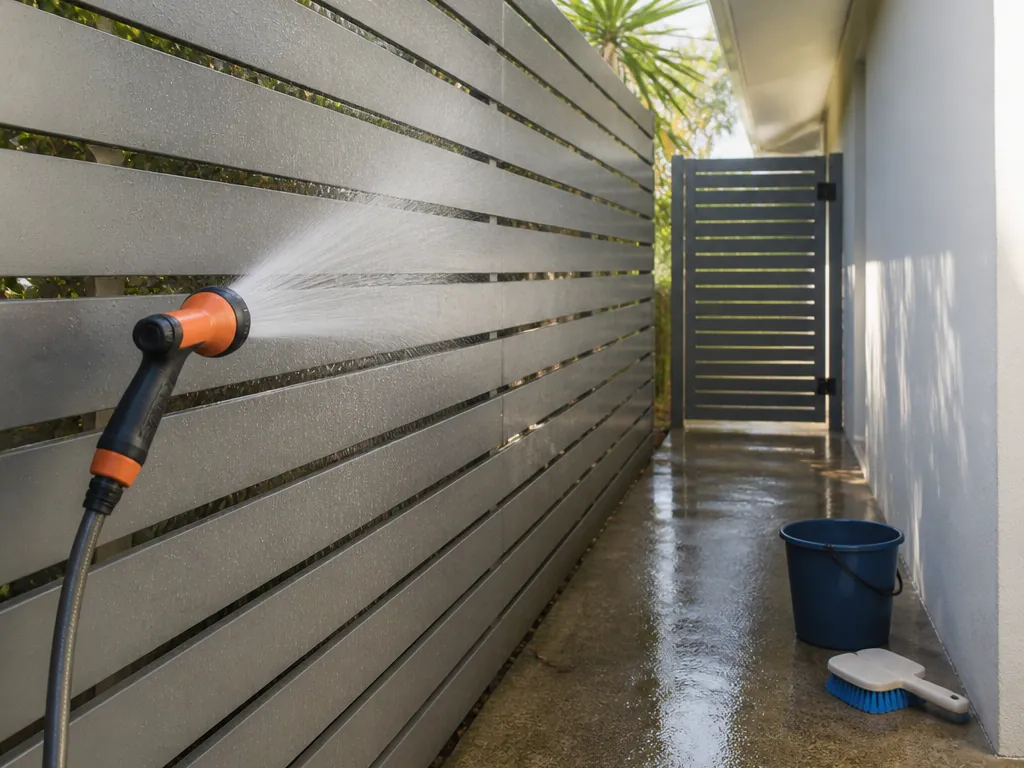
Don't skip the gate. Hinges, latches, bolt heads and the undersides of rails sit in exactly the sheltered spots where salt builds up.
What should you ask an installer before a coastal fence goes in?
Six questions cover most of it:
- Which corrosivity category have you assumed for this address, and why?
- What is the coating? For galvanised steel, ask for the zinc thickness and the standard. For pre-painted steel, ask which product.
- How will cut ends, drilled holes and welds be treated, and with what?
- How are the posts set, and will any concrete touch the rails or sheets?
- What hinges, latches and fixings are used, and do any of them mix metals?
- What does the warranty ask of me, including washing, and does it cover my distance from the water?
Council requirements are a separate question. Our notes on what councils around Newcastle want to see cover them. If the fence is on a shared boundary, read who pays for a shared boundary fence first.
Coastal steel fence at a glance
Category
- C5Within 200 m of rough seas and surf beaches (more than 500 m in some areas of Newcastle)
- C4200 m up to 1 km inland with rough seas and surf, plus harbour foreshores and sheltered bay shorelines to 50 m
- C31 to 10 km inland, extendable by prevailing winds
https://www.intumescentcoatingsystems.com.au/learning-centre/corrosivity-ratings
Coating
- 85 µm minimum average zinc for steel over 6 mm (AS/NZS 4680)
- C4 estimate roughly 20 to 40 years to first maintenance (about 5% rust)
Care
- Hose COLORBOND areas not washed by rain at least every six months, more often in coastal areas
- Rinse sheltered galvanised sections regularly
https://colorbond.com/faq
https://www.mgalv.com.au/technicalinformation/faqs/
Getting your coastal fence measured and quoted
When you book a measure and quote with Saltwater & Steel, tell us three things: your address, which way your yard faces the surf or the harbour, and which sections of the fence sit under cover. That is enough to start the category conversation before anything is ordered. You can check the areas we cover first.